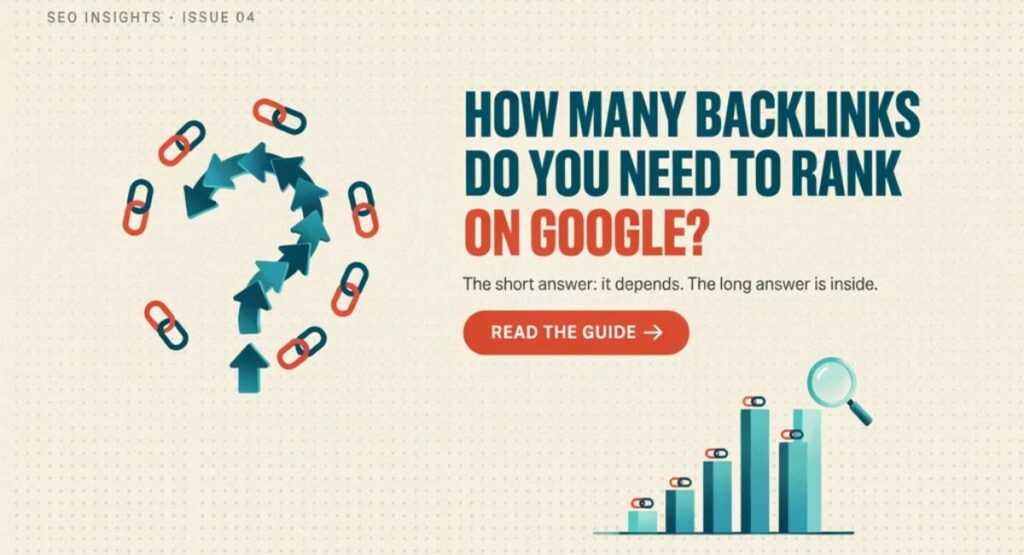
How many backlinks do I need to rank on Google? It’s one of the most common questions website owners, marketers, and SEO professionals ask when trying to improve their search performance. The truth is, there isn’t a universal number because every keyword, niche, and competitor is different.
Some pages reach the first page with only a few high authority backlinks, while others require dozens of referring domains to compete in highly competitive industries. Instead of chasing an arbitrary backlink count, you should focus on understanding your backlink gap, building a strong backlink profile, and earning relevant organic backlinks from trusted websites.
By learning how many backlinks do I need to rank on Google, you can create a smarter SEO strategy that improves rankings, drives qualified traffic, and delivers sustainable long-term growth.
- What Is the Average Number of Backlinks Needed to Rank on Google?
- What Factors Determine How Many Backlinks You Need?
- Why Referring Domains Matter More Than Total Backlinks
- How to Calculate the Exact Number of Backlinks You Need
- What Makes a High-Quality Backlink in 2026?
- How Internal Links Reduce Your Backlink Requirements
- When More Backlinks Will NOT Improve Rankings
- Best Link Building Strategies to Rank Faster
- Backlinks, AI Overviews, GEO, and LLM Rankings
- Backlink Benchmarks by Industry (2026 Data)
- How Long Does It Take for Backlinks to Impact Rankings?
- Conclusion
- FAQs
What Is the Average Number of Backlinks Needed to Rank on Google?
Many SEO studies suggest that pages ranking on the first page of Google often have between 50 and 200 quality links pointing to them. However, these averages can be misleading because every niche has different levels of keyword competitiveness.
A better approach is to compare your page against the current top-ranking pages in Google. Research consistently shows that pages with more quality referring domains tend to rank better than pages relying on large numbers of links from the same website. In competitive industries such as SaaS, legal services, healthcare, and finance, ranking often requires significantly more high-authority backlinks than in local or niche markets.
| Competition Level | Typical Referring Domains |
| Low Competition | 5–20 |
| Medium Competition | 20–75 |
| High Competition | 75–250+ |
| Enterprise Keywords | 250–1000+ |
What Factors Determine How Many Backlinks You Need?
Several variables influence your backlink target. The first is domain authority and overall website authority. A trusted website often ranks with fewer links because Google already recognizes it as a reliable source.
The second factor is content quality. A well-optimized page that perfectly matches user intent can outperform competitors even with fewer page-level backlinks. Search engines increasingly reward relevance, expertise, and usefulness.
Another important factor is keyword difficulty. Highly competitive keywords usually require stronger link equity, more robust external links, and better content than long-tail phrases. Your industry, location, and audience also affect the number of links needed to compete successfully.
Why Referring Domains Matter More Than Total Backlinks
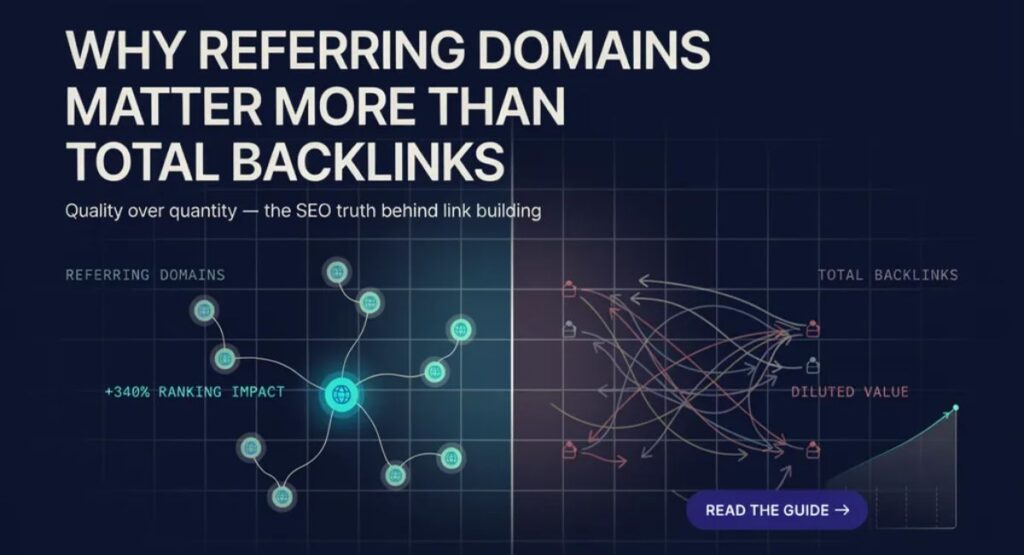
Many beginners focus on total backlinks. Unfortunately, that metric rarely tells the full story. Ten links from one website are not equal to ten links from ten different websites.
Google values diversity. Multiple referring domains act as independent votes of confidence. That’s why SEO professionals prioritize earning links from a variety of relevant websites rather than collecting dozens of links from the same source.
Think of it this way. One person recommending your business repeatedly carries less weight than ten different people recommending it once. The same principle applies to inbound links. More unique domains usually lead to stronger website credibility, greater organic search traffic, and improved ranking potential.
How to Calculate the Exact Number of Backlinks You Need
Forget generic SEO formulas. The smartest method is performing a detailed competitor backlink analysis.
Start by identifying the top five ranking pages for your target keyword. Using tools like Ahrefs or other professional SEO tools, examine their backlink profile, referring domains, content quality, and page structure.
Next, calculate the average number of quality referring domains pointing to those pages. This reveals your backlink gap. If the average competitor has 40 referring domains and your page has 10, you likely need additional quality links to become competitive.
A simple formula looks like this:
| Metric | Competitor Average | Your Page |
| Referring Domains | 40 | 10 |
| Quality Backlinks | 65 | 18 |
| Gap to Close | 30 Domains | Needed |
This process helps create realistic goals rather than guessing how many backlinks you need.
What Makes a High-Quality Backlink in 2026?
Not all backlinks provide equal value. A single link from an industry-leading publication can outperform dozens of weak directory links.
The most valuable links come from relevant content published on trusted websites. These high-authority backlinks pass stronger link juice, increase website trust, and improve SEO performance over time.
Google also evaluates context. A link embedded naturally within relevant content often performs better than a link placed in a footer or sidebar. Strong link relevance, editorial placement, and topical alignment all contribute to better results.
In 2026, the quality hierarchy generally looks like this:
| Link Type | SEO Value |
| Editorial Mentions | Very High |
| Resource Pages | High |
| Guest Posts | High |
| Industry Citations | Medium |
| Forum Backlinks | Low-Medium |
| Blog Comment Backlinks | Low |
How Internal Links Reduce Your Backlink Requirements
External links are important, but internal links remain one of the most overlooked SEO assets.
Strong internal linking distributes authority across your website. When you connect relevant pages with strategic anchor text, Google better understands the relationships among your content.
A well-built internal linking structure allows homepage backlinks and powerful pages to pass authority to deeper content. This transfer of link equity often reduces the number of external links needed for ranking.
Many successful websites improve rankings simply by strengthening internal links before launching expensive link-building campaigns.
When More Backlinks Will NOT Improve Rankings
More links do not always mean better rankings. Sometimes the problem isn’t the links at all.
If your content fails to satisfy search intent, additional links may provide little benefit. The same applies to slow websites, poor user experience, weak content depth, and keyword cannibalization issues.
Many websites spend thousands on link outreach while ignoring content quality. As a result, rankings stagnate because the page itself does not deserve to rank.
Before investing heavily in links, conduct a complete backlink audit, review content quality, and evaluate technical SEO performance. Fixing those issues often produces faster results than chasing additional backlinks.
Best Link Building Strategies to Rank Faster
The most successful SEO professionals combine several acquisition methods rather than relying on a single tactic.
Guest posting remains effective when published on authoritative and relevant websites. Strategic outreach campaigns also help secure editorial mentions and niche-specific backlinks.
Another powerful strategy involves competitor research. By studying competitor backlinks, you can identify proven backlink opportunities and replicate successful placements.
Publishing original studies, industry surveys, and unique data assets can also attract natural organic backlinks. These links tend to generate stronger trust signals because they are earned rather than requested.
Backlinks, AI Overviews, GEO, and LLM Rankings
The search landscape has changed dramatically. Ranking in traditional search results is no longer the only goal.
AI systems such as ChatGPT, Gemini, Claude, and Google’s AI Overviews frequently cite websites they consider authoritative. Strong authority websites often receive more citations because they demonstrate expertise, credibility, and topical relevance.
This shift makes off-page SEO even more important. Diverse referring domains, trusted mentions, and strong website authority increase the likelihood of appearing in AI-generated responses.
As Generative Engine Optimization (GEO) evolves, backlinks continue serving as important validation signals that help AI systems determine trustworthy sources.
Backlink Benchmarks by Industry (2026 Data)
Different industries require different levels of authority.
| Industry | Approximate Referring Domains Needed |
| Local Services | 10–40 |
| Real Estate | 50–150 |
| Healthcare | 100–300 |
| SaaS | 150–500 |
| Finance | 200–700 |
| Legal | 150–500 |
These figures are estimates, not guarantees. Actual requirements depend on your competitors, content quality, and overall SEO execution.
How Long Does It Take for Backlinks to Impact Rankings?
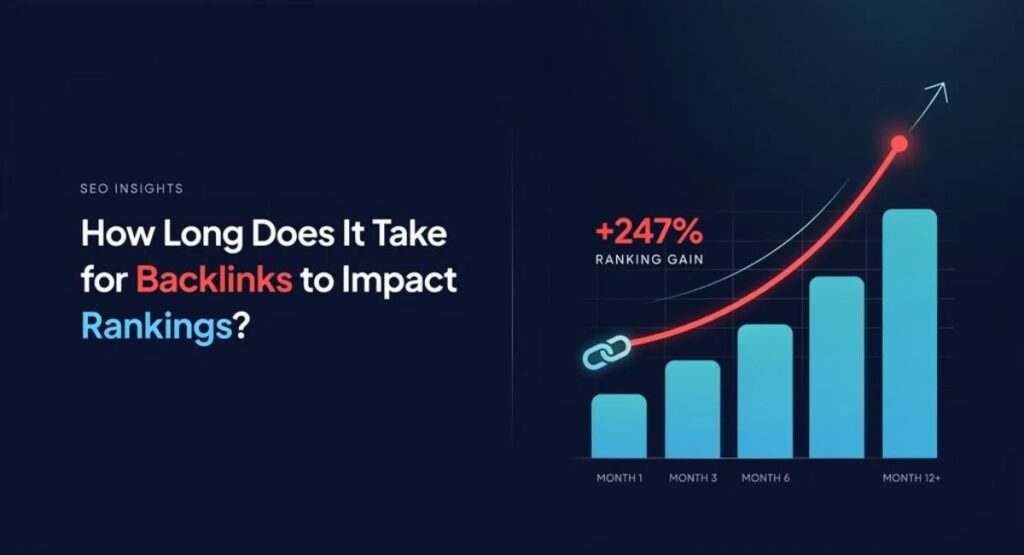
Patience remains essential in SEO. Most quality backlinks begin showing measurable effects within one to three months. Highly competitive industries may require six months or longer before significant ranking movement occurs.
Google needs time to discover, crawl, evaluate, and assign value to new links. The process becomes faster when links originate from frequently crawled websites with strong authority.
Consistent backlink growth, strong content, and ongoing optimization usually produce the best results. Instead of focusing solely on link quantity, track improvements in keyword rankings, organic visibility, search visibility, and traffic growth.
Conclusion
There is no universal answer to how many backlinks do I need to rank on Google in 2026. The right number depends on your competitors, industry, content quality, search intent, and overall SEO strategy. Instead of chasing a specific backlink count, focus on analyzing the competition and building links that genuinely add authority and relevance to your website.
If you’re still wondering how many backlinks you need to rank on Google, the best approach is to close your backlink gap, strengthen your backlink profile, improve your content, and earn relevant links from authoritative websites. When combined with a smart search engine optimization strategy, high-quality backlinks can significantly improve rankings, increase organic search traffic, and build long-term online authority.
FAQs
Is 75 a good SEO score?
Yes, an SEO score of 75 is generally considered good, but there’s still room for improvement. Aim for 85+ by optimizing content, technical SEO, and user experience.
Do backlinks still matter in 2026?
Yes, high-quality backlinks remain an important Google ranking factor in 2026. The focus is on earning relevant, authoritative links rather than building a large number of low-quality ones.
Can I rank on Google without backlinks?
Yes, it’s possible to rank without backlinks for low-competition keywords. However, competitive keywords usually require strong, authoritative backlinks to achieve top rankings.
How many backlinks should I have?
There is no ideal number of backlinks. It’s better to have a few high-quality, relevant backlinks than hundreds of low-quality or spammy ones.
Is SEO dead or evolving in 2026?
SEO is far from dead; it continues to evolve. Success in 2026 depends on creating helpful content, providing a great user experience, optimizing for AI-powered search, and earning authoritative backlinks.

Welcome to Rank Axis Agency, I’m Abdul Malik, SEO & Content Writing, Digital PR Strategist | Guest Posting, Link Building, Niche Edits & Press Releases | Helping Brands Boost Authority & Organic Traffic!